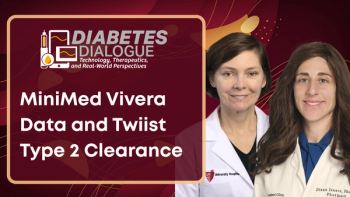
Diana Isaacs, PharmD, and Natalie Bellini, DNP, review early MiniMed Vivera data on optional meal announcements and twiist's new type 2 diabetes clearance.
The Mount Sinai expert and ACC late-breaking presentation panelist highlights her most anticipated trial data and discussions in the upcoming meeting.
Roxana Mehran, MD
Much of what highlighted 2019
In an interview with HCPLive® on the meeting agenda, the most promising trial presentations, and the move to a virtual meeting format, late-breaking presentation panelist Roxana Mehran, MD, Director of Interventional Cardiovascular Research and Clinical Trials at the Zena and Michael A. Wiener Cardiovascular Institute at Mount Sinai School of Medicine, details ACC 2020 from her expertise.
HCPLive: What exactly are you looking forward to, in terms of ACC discussion and development of therapies and practices?
Mehran: I think, even amid all of this crisis, we and the college still feels very responsible in making sure that the information on heart disease—the no. 1 killer of men and women around the globe—is shared. And I think that we have to, on a much lower scale and at the very least, share the science. I think what the college has done in a really incredible and expeditious fashion, and in a very responsible way—in having the entire meeting be online—is provide as much as they can. It's obviously never going to be the same as having everyone there in every single session taking place.
But I think it will still give an opportunity for those of us who are hunkering at home or actually on the frontlines an opportunity to still keep up with the science. And I'm extremely excited about the late-breaking clinical science.
I think one of the things that everyone needs to understand is that researchers and investigators work decades to bring forth the science that's important. And the pivotal clinical trials are the most important and really need to be shared. So in that light, and given all that's going on—and with a lot of respect to where our attention needs to be, which is COVID-19 all the way—we'll be sharing as much of the science online. I know it's going to be archived, so it still will be recognized.
The other piece that I think everyone needs to know is that the editors in the journals are working around the clock to not only share the most important and valid information regarding COVID-19, but also to share the late breaking science and what comes out of ACC and the simultaneous publication. You can imagine how hard they are working. I think what makes me proud is to see that the scientific clinician world is very much in the front lines, no matter what, and that we're there to not only share the science but also be on the front lines of treating our patients.
HCPLive: Is there anything on the agenda that stands out to you as a headlining session or presentation?
Mehran: The Innovation Group at ACC has been central to providing that kind of information. But I can tell you that we are now very, very excited about Dr. Gibson and his
I think that's going to be incredibly interesting and important for us to capture. That particular study is well underway, and patients are being randomized in a very swift fashion, using technology. Technology-based science is going to be the future, and I think we're learning more and more now—especially given what we have here with COVID-19 where we're going be working very closely with our technology colleagues to not only disseminate information, but also make diagnoses and risk-stratify our patients. I think that's a futuristic goal, which is very much here in the present.
Last year, if you remember, the opening session was pretty much focused on the Apple Heart Study. This year, the opening session on the 3 late breaking trials that would be presented: the VICTORIA Study, which is the global study in heart failure and reduced ejection fraction that was going to be presented by the Duke folks.
And then, the very exciting study of VOYAGER, which is rivaroxaban for prevention of limb events; that will be presented by Dr. Mark Bonaca.
And then, of course, the TAILOR-PCI: a long-awaited, very interesting study of clopidogrel pharmacogenetics to actually help us navigate how to treat patients with antiplatelet regimens. That was also going to be presented by Mayo Clinic colleagues. So, these are 3 very topline studies that will be presented at the time that it was originally planned for. So, we'll see how that's going to be.
HCPLive: Inclisiran, with new ORION trial program data slated for this meeting and having highlighted the
Mehran: Obviously, we are very excited about
We all need to think about how we incorporate the use of these novel agents into a better, more effective, more swift way of reducing LDL and pushing the envelope for our patients—not just those who are at high risk, but also in primary prevention. I feel that there's under-utilization, and I don't quite understand it. Of course, it's a cost issue, but the more of these agents that become available, I think there will be a lot of competitive pricing. And hopefully it will be made more available to the general public—not just those with good insurance.
I think those are the kinds of things we have to talk about, which brings everything back to affordable care and the ability to give the best therapies to pretty much everyone, and enhance health outcomes of patients with cardiovascular disease.
Let's not forget that we continue to have huge risk and residual risk of cardiovascular morbidity and mortality which burdens healthcare and the costs tremendously. So, having therapies that could be focused more on prevention rather than intervention of bad events like myocardial infarction, etc. are going to be incredibly important for the future.