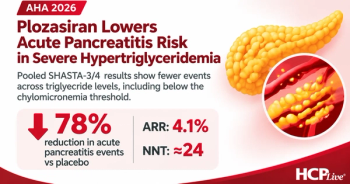
In 757 adults with severe hypertriglyceridemia, plozasiran cut acute pancreatitis events by 78% overall and 91% in those with recent prior pancreatitis.
UPlift interim data show 70.2% achieved clinical response within 12 weeks, with a median time to first response of 13 days.
For patients with
Raja Atreya, MD, head of the Inflammatory Bowel Disease (IBD) Unit and Clinical Study Centre at University Hospital Erlangen, Friedrich-Alexander University Erlangen-Nürnberg in Germany, discussed findings from the study's first 6 months in an interview with HCPLive. The data were presented at United European Gastroenterology (UEG) Week 2026 in Barcelona, Spain.²
UPlift is an ongoing, prospective, multinational, noninterventional postmarketing study evaluating the speed of onset and durability of effectiveness of upadacitinib in routine clinical practice.³ The study plans to enroll approximately 1200 adults with moderate to severe Crohn’s disease across approximately 230 sites, with follow-up extending to 3 years.³
The interim analysis included the first 500 patients who enrolled and completed month 6. Nearly 50% had lived with Crohn’s disease for >10 years, 63% had received ≥1 prior advanced therapy, and approximately 28% had received ≥3. Most patients had ileocolonic disease.
“So if I may summarize from the baseline characteristics, this is a hard to treat patient population,” Atreya said.
The prior treatment exposure and duration of disease provide context for interpreting the findings, particularly because patients receiving advanced therapies in routine practice may differ from those enrolled in registrational trials.
Among 497 evaluable patients, 70.2% achieved clinical response within 12 weeks, with a median time to first response of 13 days.¹
Clinical response was assessed using a 2-item patient-reported outcome (PRO2) measure incorporating stool frequency and abdominal pain. The endpoint required a ≥30% reduction in stool frequency and/or abdominal pain, with neither symptom worsening from baseline, and confirmation using a prospective 7-day average.¹
Atreya also described an adapted analysis based on individual daily symptom scores, in which 79.9% of patients met the response endpoint, with a median time to first response of 5 days. Separately, 68.1% reportedly achieved clinical remission, defined as a Harvey-Bradshaw Index score ≤4, at the end of induction.²
These findings reflect different outcome definitions and assessment methods. The 5-day and 13-day estimates should therefore not be interpreted as interchangeable measures of treatment response.
“And I think that’s very striking, because we did not used to talk about therapeutic effectiveness in days,” Atreya said. “This is something completely new for us.”
Atreya noted that the early symptom improvement observed in UPlift was consistent with the rapid onset reported in the registrational program supporting upadacitinib's
Atreya emphasized the clinical relevance of assessing abdominal pain and stool frequency early in treatment, particularly because both symptoms can substantially affect patients' daily functioning.
He also discussed the potential relationship between early symptom improvement and subsequent disease control. However, the interim UPlift findings do not yet establish whether patients who respond earlier are more likely to achieve sustained remission.
The distinction is relevant because early symptomatic response does not necessarily indicate resolution of intestinal inflammation or achievement of longer-term treatment targets, including endoscopic improvement.
Continued follow-up in UPlift will help characterize the durability of response and the relationship between early symptom improvement and subsequent clinical outcomes.
Although 63% of the interim cohort had received ≥1 advanced therapy and approximately 28% had received ≥3, the reported interim analysis did not provide comparative effectiveness findings stratified by prior advanced therapy exposure.
Atreya noted the challenges associated with managing patients who have not responded to multiple advanced therapies, while acknowledging that the current findings do not establish differences in upadacitinib response according to treatment history.
The ongoing study's longer follow-up may provide additional information on treatment persistence, durability of response, and outcomes across patient subgroups.
As a prospective observational study without a randomized comparator, UPlift provides information on treatment outcomes in routine clinical practice but cannot establish comparative effectiveness against other advanced therapies.
Editor's Note: Atreya reports relevant financial relationships, including speaking, consulting, or research support, with AbbVie, Johnson & Johnson, Lilly, Pfizer, and Takeda, among others.