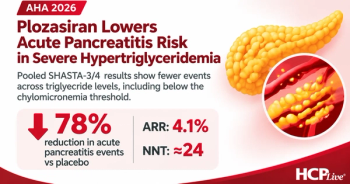
In 757 adults with severe hypertriglyceridemia, plozasiran cut acute pancreatitis events by 78% overall and 91% in those with recent prior pancreatitis.
Raja Atreya, MD, reviews adverse events and treatment discontinuation through week 26 in the real-world UPlift study.
Safety findings from the first 6 months of the real-world UPlift study provide additional information on upadacitinib (Rinvoq) use among patients with moderate to severe
In an interview with HCPLive, Raja Atreya, MD, head of the Inflammatory Bowel Disease (IBD) Unit and Clinical Study Centre at University Hospital Erlangen, Friedrich-Alexander University Erlangen-Nürnberg in Germany, discussed adverse events, treatment discontinuation, and the importance of longer-term safety monitoring. The interim findings were presented at United European Gastroenterology (UEG) Week 2026 in Barcelona, Spain.²
UPlift is an ongoing, prospective, multinational, noninterventional postmarketing study assessing upadacitinib in adults with moderate to severe Crohn’s disease treated in routine clinical practice.³ Approximately 1200 patients are expected to be enrolled, with planned follow-up extending to 3 years.³
The
Atreya emphasized the role of observational studies in evaluating treatment outcomes among patients who may not meet the eligibility criteria of randomized controlled trials.
“I think there are some studies that tell us that only every third patient that we see in daily clinical practice meets the inclusion and exclusion criteria of registration trials,” he said.
The UPlift interim analysis included the first 500 patients who completed month 6. Nearly half had lived with Crohn’s disease for >10 years, 63% had received ≥1 prior advanced therapy, and approximately 28% had received ≥3.
The treatment history of the cohort provides context for interpreting safety findings in a population with substantial prior exposure to advanced therapies.
According to interim findings discussed by Atreya, 32% of patients experienced treatment-emergent adverse events considered potentially related to upadacitinib through week 26. Serious treatment-emergent adverse events occurred in 3.8%, while 6.6% discontinued treatment due to an adverse event. No deaths were reported during the observation period.²
Atreya highlighted treatment discontinuation as an important outcome when evaluating tolerability in routine clinical practice. He characterized the 6.6% discontinuation rate as acceptable in the context of the cohort's treatment history and the 26-week observation period.
However, discontinuation rates alone do not capture the full burden or severity of adverse events. Some clinically important events may be managed without treatment cessation, while discontinuation decisions can also reflect patient preferences, comorbidities, and clinician judgment.
Atreya described the interim safety findings as consistent with the safety profile observed in previous upadacitinib clinical trials, with no new safety signals reported through week 26. However, the observational design and limited follow-up period do not establish long-term safety or exclude uncommon adverse events.
Upadacitinib is a Janus kinase (JAK) inhibitor with established safety warnings, including risks of serious infections, malignancy, major adverse cardiovascular events, thrombosis, and mortality.⁴
These risks remain relevant when interpreting observational safety data, particularly in patients with additional risk factors or substantial prior treatment exposure.
Because UPlift does not include a randomized comparator, the interim analysis cannot determine whether adverse event rates are higher or lower than those associated with other advanced therapies for Crohn’s disease.
The findings also cannot establish whether the observed safety outcomes differ according to prior advanced therapy exposure, disease duration, or other baseline characteristics without further subgroup analyses.
Atreya emphasized the importance of continued monitoring in Crohn’s disease, given its chronic, relapsing course and the potential need for prolonged treatment.
“We are partners for the patients for life in Crohn’s disease, because indeed it’s a lifelong chronic condition with remitting and relapsing phases,” he said. “So I think understanding how patients respond to treatment over time in everyday clinical practice is critical.”
The planned 3-year follow-up will provide additional information on treatment persistence, adverse events, and the durability of effectiveness in routine clinical practice.
Longer observation may also help characterize safety outcomes among patients with different treatment histories, although uncommon adverse events may require larger populations or additional data sources for reliable assessment.
For now, the 26-week findings provide an early description of tolerability and treatment discontinuation in a real-world cohort, rather than a definitive assessment of long-term safety.
Editor's Note: Atreya reports relevant financial relationships, including speaking, consulting, or research support, with AbbVie, Johnson & Johnson, Lilly, Pfizer, and Takeda, among others.