

Route of administration is becoming a more balanced decision as newer oral therapies narrow historical differences in treatment efficacy.

Linda Stein Gold, MD, is a dermatologist at Henry Ford Health.
Route of administration is becoming a more balanced decision as newer oral therapies narrow historical differences in treatment efficacy.
Recognizing psoriasis as a systemic disease may help clinicians move appropriate patients beyond repeated topical treatment.
As therapies improve, complete clearance and meaningful quality-of-life gains are increasingly shaping expectations for psoriasis care.
Advances across topical, biologic, and oral therapies are expanding the possibilities for individualized systemic psoriasis care.
Linda Stein Gold, MD, discusses LATITUDE Atlas data showing zasocitinib achieved higher PASI 100 rates than deucravacitinib in psoriasis.
Linda Stein Gold, MD, and Andrew Blauvelt, MD, MBA, discuss 2-year ICONIC-TOTAL data supporting icotrokinra's benefit for scalp, genital, and hand/foot PsO.
Linda Stein Gold, MD, discusses age-stratified ADORING data on tapinarof cream for atopic dermatitis, presented at the 2026 SPD Annual Meeting.
Linda Stein Gold, MD, discusses ADORING trial endpoints and remaining treatment gaps in the youngest patients with atopic dermatitis.
Linda Stein Gold, MD, explains what new ADORING data reveal about tapinarof cream for atopic dermatitis across age cohorts.
New phase 3 data show tapinarof cream (VTAMA) delivered early, consistent efficacy across pediatric and adult age groups with atopic dermatitis.
Most newer nonsteroidal topical options are now approved for children as young as 2 years. Linda Stein Gold, MD, discusses adherence and misconceptions of pediatric AD.
New topical mechanisms introduce more ways to control pediatric AD without the sting, burn, or long-term steroid concerns that limit adherence, Linda Stein Gold, MD, says.

Experts explain managing psoriasis biologic failures: reassess response, use topicals, and switch smarter to reach near‑clear skin.
Learn how experts tackle psoriasis biologic failures—assess primary vs secondary loss, use topicals, and choose smarter switches for clearer skin.
IL-17 inhibitors clear psoriasis fast; meta-analyses highlight brodalumab, bimekizumab and ixekizumab, with flexible dosing that builds patient confidence.
Clinicians unpack dual IL‑17A/F blockade in psoriasis and reveal why long‑term efficacy claims vary without rigorous head‑to‑head data.
Expert panel weighs IL‑17 vs IL‑23 biologics for psoriasis, highlighting fast onset, durability, and why switching within class may work.
Explore which psoriasis biologics deliver rapid clearance and durable remission, including IL-17 vs IL-23 insights and key differences within IL-17 inhibitors.
New psoriasis data show durable, rapid skin clearance with modern biologics, spotlighting bimekizumab’s four-year remission and patient-tailored selection.
Explore how psoriasis biologics differ—TNF vs IL‑23/IL‑17—why classes matter, and what targeted therapy means for safety and results.

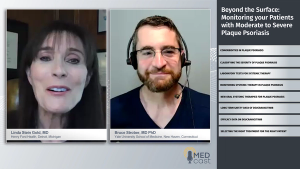
In the final episode, "Integrating Comparative Evidence to Optimize Psoriasis Treatment Decisions," the panelists explore how the full body of available evidence, including comparative analyses, long term extension studies, real world data, and clinical experience, can be integrated into practical treatment decision making for plaque psoriasis.
In this episode, "Evaluating IL-23 Inhibitors with Long-Term Data and Real-World Evidence," the expert dermatologists explore the distinct but complementary roles of long term extension studies and real world evidence in evaluating the durability and safety of biologic therapies for plaque psoriasis.
Ambitious psoriasis remission targets spark clinician debate, urging treatment tweaks to achieve sustained clearance, improve quality of life, and reduce comorbidity risks.
Experts share treat-to-target psoriasis goals, when to switch biologics, and how near-clear skin may reduce arthritis risk.
This episode, titled "Continuing the Conversation on Treatments in Psoriasis," features panelists discussing the value and limitations of network meta-analyses as a tool for comparing multiple psoriasis therapies across different clinical trials simultaneously.
In "Evaluating Psoriasis Therapies using MAICs," our panel delves into several recent and clinically meaningful MAIC analyses comparing biologic therapies for plaque psoriasis, examining what the data reveals about relative efficacy across treatment classes and how these analyses have been validated over time.

In this episode, ‘Redefining Treatment Success in Psoriasis,’ the expert dermatologists explore the remarkable evolution of treatment expectations in psoriasis, moving from modest improvements to ambitious goals of complete skin clearance and sustained remission. The faculty reflect that in earlier treatment paradigms even a 50% improvement in disease severity was considered a meaningful success.
Welcome back to another HCP Live Peer Exchange series. In this episode titled, ‘Evolving Treatment Expectations in Psoriasis,’ the panelists discussed how treatment goals in psoriasis have evolved alongside advances in therapeutic innovation and disease understanding. The expert faculty began by reflecting on the historical limitations of traditional therapies, including topicals, phototherapy, and early systemic agents, which were often insufficient for achieving sustained disease control. In earlier eras, treatment success was defined and accepted by improvement rather than complete clearance of the skin.
In this episode, "Value of Utilizing Matching-Adjusted Indirect Comparisons (MAICs) in Psoriasis," the expert dermatologists explore the methodology behind matching adjusted indirect comparisons and their practical value in guiding evidence based treatment decisions for plaque psoriasis.
This episode, titled "Analyzing IL-23 Inhibitors in Psoriasis," features panelists discussing the future of IL-23 targeted therapies and the practical considerations surrounding the anticipated shift toward oral treatment options in plaque psoriasis.
June 26th 2024

June 1st 2022

April 15th 2026

