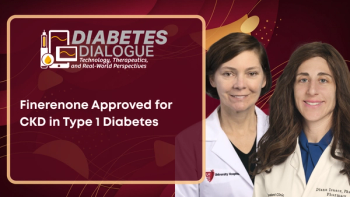
Diana Isaacs, PharmD, and Natalie Bellini, DNP, discuss the FDA's recent approval of Bayer's finerenone in concomitant CKD and T1D.

This episode covers the recent release of new data on Eledon’s tegoprubart for islet cell transplantation in patients with T1D.
Welcome back to
To begin the episode, hosts Diana Isaacs, PharmD, and Natalie Bellini, DNP, discuss recent advances in type 1 diabetes (T1D) research following presentations at the American Diabetes Association (ADA) Scientific Sessions and the American Association of Clinical Endocrinology (AACE) Annual Meeting. They focus on promising data from an islet cell transplantation study in which all 12 participants achieved insulin independence, with some maintaining normal glycemia for up to 2 years after transplantation.
Isaacs explains that the transplanted islet cells restore endogenous insulin production and emphasizes that the study’s most notable innovation is its immunosuppression strategy. Rather than relying on calcineurin inhibitors such as tacrolimus, which are associated with significant toxicities, particularly nephrotoxicity, the investigators used the investigational anti-CD40 ligand therapy tegoprubart. The hosts discuss how this approach may improve the long-term safety and feasibility of islet transplantation and note ongoing efforts to develop more convenient formulations beyond the current intravenous infusion administered every 3 weeks.
The conversation then turns to the clinical significance of the findings. Bellini highlights that all 12 enrolled participants achieved insulin independence, distinguishing these results from earlier transplantation efforts such as the Edmonton protocol. The hosts also describe the substantial improvements in quality of life reported by participants, including sustained HbA1c values in the normal range without restrictive dietary practices and complete resolution of severe hypoglycemia. Because the trial enrolled individuals with recurrent, life-threatening hypoglycemia, they emphasize that the observed benefits are particularly meaningful for this high-risk population.
The hosts also examine several unanswered questions that remain before this approach can become widely available. They discuss the durability of insulin independence, the long-term need for immunosuppressive therapy, treatment costs, and the challenges associated with scaling islet transplantation beyond specialized research centers. Additional findings are reviewed, including the need for repeat transplantation in 2 participants and observations suggesting that individuals with higher body mass index may require greater islet mass to achieve insulin independence. They also discuss the use of tirzepatide in 2 participants, raising questions about the role of insulin resistance and adjunctive therapies following transplantation.
Broadening the discussion, Isaacs and Bellini review several emerging strategies aimed at expanding access to curative therapies. These include stem cell-derived islets, large-scale beta cell manufacturing, gene-editing approaches, and encapsulation technologies intended to protect transplanted cells while reducing or eliminating the need for chronic immunosuppression. Drawing on presentations from Aaron Kowalski, PhD, and Laura Jacobsen, MD, they emphasize that despite major advances in continuous glucose monitoring, automated insulin delivery systems, and adjunctive pharmacotherapy, subcutaneous insulin administration remains fundamentally nonphysiologic and cannot fully eliminate long-term complications or disease burden.
The episode concludes with a broader discussion of the future of type 1 diabetes research. The hosts highlight efforts to expand eligibility for islet transplantation trials, including studies involving individuals with chronic kidney disease who were previously excluded because of concerns surrounding traditional immunosuppressive therapies. They also underscore the importance of continuing to pursue disease-modifying therapies despite improvements in diabetes technology, emphasizing that glycemic targets alone do not eliminate complications or address disparities in access to care. While acknowledging that a universally applicable cure remains years away, Isaacs and Bellini conclude that the field is making meaningful progress toward safe, durable, and scalable therapies capable of fundamentally changing the treatment of type 1 diabetes.
Editors’ Note: Isaacs reports disclosures with Dexcom, Abbott, Lilly, Novo Nordisk, Medtronic, Insulet, and others. Bellini reports disclosures with Abbott Diabetes Care, MannKind, Povention Bio, and others.