
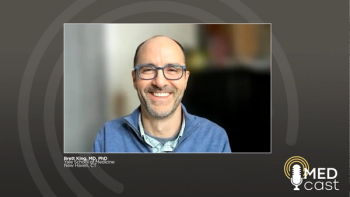
Dr. Brett King shares novel mechanisms of action under research for the treatment of alopecia areata in different age groups.
Dr. Brett King shares novel mechanisms of action under research for the treatment of alopecia areata in different age groups.
The expert panel discusses the secondary analysis from the phase 3 BRAVE clinical trials of baricitinib in alopecia areata.
Drs. Raj Chovatiya, George Han, and Brett King discuss the use of baricitinib for the treatment of moderate to severe alopecia areata.
The expert panel highlights the psychosocial burden of alopecia areata on patients and discusses the current treatment paradigm.
Drs Raj Chovatiya, George Han, and Vivian Shi review the current challenges and opportunities surrounding the utilization and availability of biologic therapies in atopic dermatitis.
Expert dermatologists highlight the burden of atopic dermatitis in young children and examine the clinical data for dupilumab, a biologic treatment for this age group.
The expert panel discusses the heterogeneity of atopic dermatitis manifestation and therapy decisions for individual patients.
Dr Vivian Shi provides an overview of treatment options for atopic dermatitis patients in different age groups.
Brad Glick, DO, AOCD, George Han, MD, PhD, and Neal Bhatia, MD, look to the future at what is upcoming in the treatment pipeline for plaque psoriasis treatment.
Dermatology experts discuss looking ahead at clinical trial metrics and how to make different outcomes more highlighted to overcome challenges in plaque psoriasis.
Brad Glick, DO, AOCD, George Han, MD, PhD, and Neal Bhatia, MD, discuss treating older populations and skin of color patients with plaque psoriasis.
Dermatology experts discuss BMI and other background comorbidities that can impact IL-23 inhibitors when treating plaque psoriasis.
Brad Glick, DO, AOCD, George Han, MD, PhD, and Neal Bhatia, MD, discuss year long term efficacy and safety data regarding the use of IL-23 inhibitors in patients with moderate to severe plaque psoriasis.
Dermatology experts discuss how IL-23 inhibitors fit into the current treatment landscape for plaque psoriasis.
George Han, MD, PhD, provides an overview of the long-term persistence of different biologic treatment options for plaque psoriasis.
Neal Bhatia, MD, discusses the impact of treatment mode of delivery on patient adherence and treatment selection for IL-23 inhibitors for plaque psoriasis.
Dermatology experts provide an overview of tildrakizumab, guselkumab, and risankizumab, agents approved for patients with plaque psoriasis.
Brad Glick, DO, AOCD, George Han, MD, PhD, and Neal Bhatia, MD, discuss communicating with patients about their plaque psoriasis treatment options.
George Han, MD, PhD, discusses the practical considerations of escalating treatment to the use of traditional oral systemic agents such as apremilast or methotrexate.
Neal Bhatia, MD, provides an overview of the spectrum of disease, topical choices, and transitioning to oral medications for the treatment of plaque psoriasis.
Brad Glick, DO, AOCD, George Han, MD, PhD, and Neal Bhatia, MD, discuss the current role of topical therapy and the use of non-biologic oral systemic and standard therapies for plaque psoriasis treatment.
Dermatology experts discuss the rapid expansion of the treatment armamentarium of plaque psoriasis and how has it shifted treatment approaches to plaque psoriasis.
Brad Glick, DO, AOCD, leads a discussion about the current therapeutic landscape and approval of various biologics therapies for the management plaque psoriasis.
Key opinion leaders conclude their discussion on plaque psoriasis by commenting on the potential for research into the genetic origin of disease, possible biomarkers, and treatment options with greater efficacy.
A group of specialists discusses unmet needs in psoriatic disease including physician education about biologics and research about treatment options for pediatric patients, patients with malignancies, and patients who are pregnant.
A panel of experts builds a lively discussion on the evolving treatment landscape in plaque psoriasis and highlights the emergence of IL-23 inhibitors as a new class of biologic agents.
Thought leaders in the management of plaque psoriasis share personal insights into factors to consider when treating patients with IL-23 inhibitors, including when to switch biologic agents.
Erin Boh, MD, PhD, FAAD, guides the panel in a conversation about the phase 3 and long-term extension data from the VOYAGE 1 and VOYAGE 2 clinical trials of guselkumab in patients with moderate to severe plaque psoriasis.
George Han, MD, PhD leads a discussion on the pooled analysis of the phase 3 reSURFACE 1 and reSURFACE 2 clinical trials assessing the 5-year safety and efficacy of tildrakizumab in patients with moderate-to-severe psoriasis.
An expert in the management of plaque psoriasis, Erin Boh, MD, PhD, FAAD, highlights the importance of considering comorbidities, prior treatment, health care cost, and insurance when stratifying patients for treatment with biologics.