
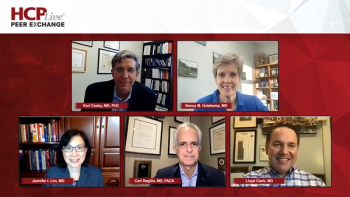
Nancy L. Holekamp, MD, defines age-related macular degeneration (AMD), while Jennifer I. Lim, MD, discusses signs and symptoms that are usually present in patients before diagnosis.
In this Peer Exchange, a panel of specialists examine the current and developing treatment options for age-related macular degeneration, with a focus on faricimab.
Nancy L. Holekamp, MD, defines age-related macular degeneration (AMD), while Jennifer I. Lim, MD, discusses signs and symptoms that are usually present in patients before diagnosis.
Carl Regillo, MD, FACS, discusses diagnosing patient with age-related macular degeneration.
Lloyd Clark, MD, provides examples of when clinicians should refer patients with AMD to specialists, and Carl Regillo, MD, FACS, explains the typical therapy goals a specialist has for each patient.
Lloyd Clark, MD, and Jennifer I. Lim, MD, give their insight into therapy considerations when deciding to use anti-VEGF agents to treat age-related macular degeneration.
Nancy M. Holekamp, MD, and Carl Regillo, MD, FACS, discuss the safety aspects of anti-VEGF agents when treating age-related macular degeneration.
Dr Clark details additional diagnostic tools he uses when deciding to use anti-VEGF agents, as well as his experience using the drug brolucizumab, and Dr Regillo elaborates on brolucizumab.
Drs Lim, Holekamp, and Regillo discuss the introduction of the drug faricimab as a therapy option for age-related macular degeneration and the data from the TEYANA and LUCERNE clinical trials.
Two specialists examine the YOSEMITE and RHINE clinical trials that explored faricimab as a therapeutic option for patients with both diabetes and age-related macular degeneration.
Two specialists give their insight into a VEGF inhibitor that could potentially be used as an effective treatment for age-related macular degeneration: port delivery system.
Lloyd Clark, MD, discusses a different VEGF inhibitor that could have a positive effect on age-related macular degeneration treatment: KSI-301.
The panel closes out this Peer Exchange by relaying their idea of unmet needs found when using the available treatment options for age-related macular degeneration.