

Opinion|Videos|November 9, 2026
Individualizing Oral Therapy Selection for Patients With PsO
Selecting an oral psoriasis therapy requires balancing disease characteristics with efficacy, convenience, comorbidities, and individual patient priorities.
Advertisement
Episodes in this series
In ‘Individualizing Oral Therapy Selection for Patients With PsO,’ our panel explores how clinicians identify patients who may benefit from oral systemic therapy and how they distinguish among available options. The experts note that oral treatment may be particularly attractive to patients who are systemic-therapy naïve, prefer pills to injections, travel frequently, or value the flexibility associated with shorter drug exposure.
The discussion then examines how different oral therapies may fit different clinical scenarios. Faculty review the role of apremilast in patients with milder overall disease or involvement of high-impact sites such as the scalp, nails, palms, and soles. They discuss deucravacitinib as a more efficacious oral option for moderate-to-severe disease and note additional considerations related to psoriatic arthritis. The panel also considers icotrokinra for moderate-to-severe psoriasis, including younger eligible patients and those with high-impact-site involvement.
Head-to-head evidence is highlighted as an increasingly valuable tool for differentiating oral therapies. The faculty discuss the progression in efficacy seen across generations of oral treatment and how patient selection may also depend on speed of response, psoriatic arthritis, and willingness to use injectable therapy.
The experts conclude by reviewing high-level efficacy trends and emphasizing that patients with localized high-impact disease may experience substantial burden despite low body surface area.
Our next episode, ‘High-Impact Site Clearance and Durability With Oral IL-23 Inhibition in PsO,’ focuses on extended icotrokinra data in high-impact-site disease and explores the biology that may contribute to sustained response.
Advertisement
Related to this article

Topline results presented at The Liver Meeting showed 79% of patients with HDV reached undetectable HDV RNA at 48 weeks with monthly elebsiran plus tobevibart.
Kausik Ray, MD, MBChB, MPhil, discusses Lp(a)HORIZON, remnant cholesterol targets, enlicitide, and the lipid outcome trials to watch in 2027.

In the phase 2b IMPACT trial, up to 42.9% of patients with MASH achieved concurrent liver fat, ALT, and stiffness responses on pemvidutide vs 3.3% on placebo.
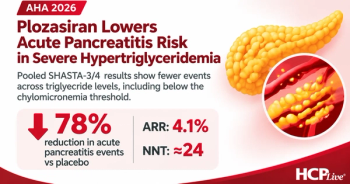
In 757 adults with severe hypertriglyceridemia, plozasiran cut acute pancreatitis events by 78% overall and 91% in those with recent prior pancreatitis.

End-of-study B-Well data show 91% of patients with chronic hepatitis B who achieved functional cure with bepirovirsen maintained it through Week 96.

With LDL-C target-guided titration, starting statin plus ezetimibe vs a statin alone yielded similar 3-year events in ASCVD.

Stopping statins was noninferior at 2 years in adults 70 and older without CVD, but events were higher over full follow-up (12.7% vs 9.2%).

Post hoc phase 2 data show survodutide improved MASH and fibrosis endpoints across all weight loss categories, including patients losing less than 5%.
Advertisement
Advertisement
Trending on HCPLive
1
Bepirovirsen Functional Cure Durable Through Week 96 in Chronic Hepatitis B
2
STREAM: Statin Discontinuation Noninferior in Older Adults Without CVD
3
Lp(a)HORIZON, Oral PCSK9s, and 2027 Lipid Trials, with Kausik Ray, MD, MBChB, MPhil
4
ESSENCE: Semaglutide Improves Liver Markers in MASH Without Obesity
5