
Study results show that incorrect use of inhalers and epinephrine autoinjectors is widespread among patients, which should prompt treating physicians to focus more on educating patients on proper use.
Study results show that incorrect use of inhalers and epinephrine autoinjectors is widespread among patients, which should prompt treating physicians to focus more on educating patients on proper use.

Study results indicate that the increasing rate and severity of obesity in western nations has rendered today's epinephrine autoinjectors an ineffective anaphylaxis treatment for many people.

A team from MedUni Vienna has demonstrated that testosterone increases the number of proteins that transport serotonin into the brain.

Results from a recent survey indicate that efforts to educate American doctors about the diagnosis and treatment of anaphylaxis have achieved mixed results.

A paper from a pair of physicists may reveal significant new information about the causes of atrial fibrillation and help to make cardiac ablations a more effective treatment for the condition.
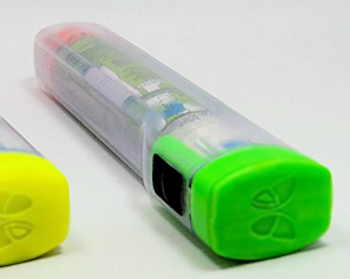
Aterica Digital Health, based in Waterloo, Canada, has designed an EpiPen case that's difficult to lose or leave behind.The "Veta smart case" uses sensors, Bluetooth radios and other technology to broadcast its location and perform several other tricks that could help users survive anaphylaxis. The case itself works with an app that runs on either Apple iOS or Google Android. Whenever a user's smartphone and case get too far apart to communicate, an alert appears on the phone. If a user misplaces a case, the app can reveal its exact location by tracking the signal it emits.

New research indicates that an over-the-counter supplement doesn't raise testosterone levels but a widely used class of prescription drug may lower them.

Four separate cases of fatal anaphylaxis, all within days of each other, vividly illustrate both the extreme difficulty of avoiding known food allergens and the potential consequences of any given exposure.

A new analysis of several prospective health studies indicates that low testosterone levels at any age are associated with an increased risk ischemic stroke in men.

Allergists have long known that women are more likely than men to suffer severe allergic reactions such as anaphylaxis, but a new study may finally explain why.
A new study finds that low testosterone levels are associated with frailty and other health problems in men with Human Immunodeficiency Virus.

How much can you predict about what people will do by measuring the testosterone in their saliva?

In the first documented instance of its kind, a child was recently successfully treated for severe anaphylaxis triggered by eating an orange.

Researchers from Vanderbilt University have developed a new tool for deciding when hospitals should admit patients with symptomatic atrial fibrillation and when they should send them home.

Sublingual immunotherapy was developed nearly 30 years ago as an alternative to subcutaneous immunotherapy, an alternative that might trigger fewer systematic reactions such as anaphylaxis.

Researchers from Germany believe they have improved upon current methods for diagnosing wheat-dependent exercise-induced anaphylaxis (WDEIA) - and demonstrated that the condition isn't necessarily induced by exercise.

Why do some allergic reactions produce only relatively mild symptoms while others trigger anaphylaxis and eventual death?

A meta-analysis of many older studies may explain the recent observation that patients with atrial fibrillation (AF) frequently suffered cognitive impairment without suffering from any signs of stroke.

New research suggested that men with the sort of wider faces that indicate higher testosterone levels show greater dominance and fare better than narrow-faced men in negotiations.

A new study indicates that medications produce far more fatal cases of anaphylaxis than either venom or food.

Do women prefer the sort of masculine faces that indicate high testosterone levels? New research suggests that the answer may depend upon where you live, but if you live in an advanced market economy, the answer is probably "yes."

Do longer periods of androgen-deprivation therapy significantly improve prostate cancer survival rates or needlessly impair quality of life for recovering patients?

New research indicates that doctors who treat anaphylaxis with intravenous epinephrine rather than intramuscular or subcutaneous injections are increasing the risk that patients will suffer overdoses or other adverse reactions.

New research suggests that oral immunotherapy may trigger anaphylaxis in an unusually high percentage of asthmatic teenagers with high-risk food allergies who failed to adhere to their management plan.

A common treatment for opioid addiction significantly reduces testosterone levels in many male patients; researchers suggest that supplementary testosterone might improve outcomes.

When managing patients with atrial fibrillation, internists use antiarrthymic strategies that significantly differ from those utilized by cardiologists, though both types of physicians similarly diverge from treatment guidelines.
New research on the link between antihypertensive medications and atrial fibrillation suggests diuretics may trigger new cases of the condition, while angiotensin-converting enzymes may protect against it.

Researchers in Australia have released the results of a study showing that dropping testosterone levels in older men could potentially put them at risk when taking care of themselves in their later years.

Preliminary research suggests that optogenetics could eventually replace electric shocks in the treatment of atrial fibrillation.

This marks the first testosterone nasal gel for replacement therapy in adult males approved by the FDA for conditions associated with a deficiency or absence of endogenous testosterone.