
Experts conclude this series highlighting what is on the horizon of retinal disease care.
Diana Do, MD
Vice Chair of Clinical Affairs
Professor of Ophthalmology
Byers Eye Institute
Stanford University School of Medicine
Palo Alto, CA
Experts conclude this series highlighting what is on the horizon of retinal disease care.
Experts discuss challenges in integrating gene therapy and port delivery systems early in treating common retinal diseases while emphasizing historical challenges and safety considerations.
Experts continue their discussion of gene therapy, highlighting safety concerns and the need for more trials and data.
Experts shift to the prospect of gene therapy in treating retinal diseases.
Experts discuss the use of biosimilars in treating neovascular age-related macular edema (nAMD) and diabetic macular edema (DME).
Experts discuss the safety of aflibercept 8 mg, emphasizing familiarity, efficacy, and durability, supported by reassuring data from the two-year PULSAR and PHOTON studies.
Experts discuss the practice of loading doses for newer agents and when they would consider this suitable for patients.
Experts discuss the importance of fluid management, presenting a range of perspectives on managing complex cases.
Experts reflect on the current information available on the safety and durability of second-generation agents aflibercept 8 mg and faricimab.
Experts share their real-world experience with aflibercept 8 mg, comparing it to its predecessor, aflibercept 2 mg.
Experts share their real-world experience with second-generation therapies, focusing on faricimab.
Experts discuss the timing of switching agents, particularly when switching to newer agents like aflibercept 8 mg or faricimab.
Experts expand on the discussion of first-line therapy choice, discussing how insurance mandates may alter treatment paths and the importance of catering to patient goals.
Experts discuss the importance of optimizing first-line therapies in the treatment of retinal diseases like neovascular age-related macular degeneration (nAMD) and diabetic macular edema (DME).
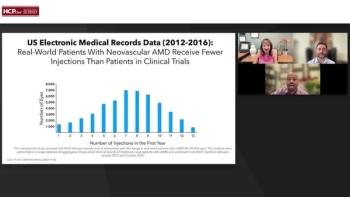
Diana Do, MD, provides an overview of neovascular age-related macular degeneration (nAMD) and diabetic macular edema (DME).
Carl Regillo, MD and Diana Do, MD react to newer therapies being explored for wet AMD and discuss their place in future therapeutic algorithms.
An overview of new gene therapy options for wet AMD that are currently being explored in clinical trials.
Results of recent phase III clinical trials with respect to efficacy and safety of faricimab, an investigational bispecific antibody which inhibits both VEGF-A and angiopoietin-2.
Retina specialists provide insight into the patient selection and safety concerns with the innovative Port Delivery System (PDS) that offers a new means of sustained anti-VEGF therapy.
Carl Regillo, MD highlights the Port Delivery System (PDS), a new surgical implant with sustained release of anti-VEGF therapy that recently completed phase III clinical trials.
Carl Regillo, MD and Diana Do, MD discuss the safety concerns with the use of brolucizumab in wet AMD and the impact of these concerns in their practice.
An overview of standard anti-VEGF treatments for wet AMD and recommendations for individualizing patient therapy with a treat and extend approach.
Role of imaging modalities in the diagnosis and monitoring of age-related macular degeneration (AMD).
Carl Regillo, MD and Diana Do, MD, describe the progressive nature of age-related macular degeneration (AMD) and differences between dry AMD and wet AMD.
May 17th 2021
May 17th 2021