

Lacy reviews key considerations for the diagnostic evaluation and treatment of abdominal bloating and distension based on his session at DDW.
Lacy reviews key considerations for the diagnostic evaluation and treatment of abdominal bloating and distension based on his session at DDW.

Aby describes findings from a pair of studies presented at DDW exploring the prevalence and impact of financial burden in liver transplant candidates.

Singh explains a potential new approach to the low FODMAP diet based on findings from research he presented at DDW suggesting a simplified step-up method.

Krugliak Cleveland explains findings from research she presented at DDW comparing intestinal ultrasound and conventional approaches to disease monitoring in IBD.

Rezaie reviews findings from a prospective clinical trial of a novel palatable elemental diet, highlighting its 100% compliance rate and strong efficacy.

Panaccione explains findings from GALAXI 2 and GALAXI 3 demonstrating guselkumab’s superiority to ustekinumab in Crohn’s disease, presented at DDW.

Joly explains the burden of parenteral support and the significance of new STARS data showcasing apraglutide’s potential in SBS-IF.
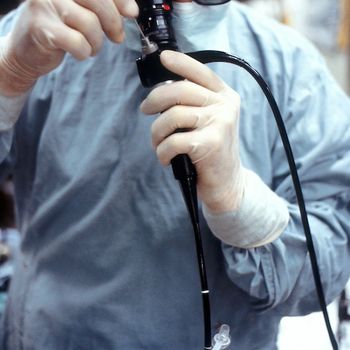
A cable-transmission magnetically controlled capsule endoscopy showed comparability to conventional methods in upper GI tract examinations and lesion detection.

Alkhouri explains survodutide’s mechanism of action as a glucagon/GLP-1 receptor dual agonist and reviews key findings about its use in MASH from the interim analysis.

Data from PREEMPT CRC reveal the blood-based screening test demonstrated a 79.2% sensitivity for detecting colorectal cancer.

A detailed overview and accompanying quiz on the recommendations made by the AGA in their 2024 guideline on endoscopic eradication

End-of-study results from the phase 3 REGENERATE study were presented at DDW and highlight obeticholic acid’s trend in benefit for clinical outcomes.
Both doses of guselkumab exhibited statistical superiority on all prespecified pooled endoscopic endpoints versus ustekinumab in Crohn's disease.

New STARS data were presented in a late-breaking abstract at DDW and build upon positive topline results for clinical responder rates and reductions in parenteral support.

Feuerstadt breaks down findings from an ad hoc analysis of PUNCH CD3 and what the results suggest about the use of live-jslm (Rebyota) in patients taking concomitant medications.

The phase 3 QUASAR Maintenance study met its primary endpoint of clinical remission and demonstrated statistically significant endoscopic remission rates in UC treatment.

Sehgal explains the safety and efficacy of GLP-1RAs in patients with IBD as well as the impact on inflammatory biomarkers.

Damas explains key findings from her pilot study exploring intervals of a low-calorie plant-based diet as adjunctive therapy to medication in patients with ulcerative colitis.
Rezaie describes recent trends in GLP-1RA prescription patterns from his population-based research presented at DDW, highlighting increases in off-label use.

Dolinger reviews findings from his research presented at DDW about the use of intestinal ultrasound response for predicting endoscopic outcomes in children with UC.

TNF-α levels in the sweat correlate with serum values in patients with IBD, suggesting the wearable's feasibility in non-invasive disease monitoring.
Damas explains what inspired her research about the impact of a low-calorie plant-based diet on clinical response to medication in patients with ulcerative colitis.

Microbiota differences between individuals with and without MAFLD were associated with dietary intake and clinical outcomes.

Findings were presented at DDW and highlight the feasibility of breath analysis for microbiome metabolic characterization in the digestive system.

Zhang explains disparities in HCC care and the negative impact on long-term outcomes, also addressing potential considerations for vulnerable patient populations.

The MyGut digital health monitoring platform proves feasible and impactful during integration into inflammatory bowel disease care.

Results presented at DDW detail the association between ALT, Fibroscan CAP, Fibroscan VCTE, and histological response to resmetirom in patients enrolled in MAESTRO-NASH.

Higher exposure dupilumab significantly improved histologic and endoscopic outcomes in children with EoE aged 1 to <12 years.

Dubinsky explains the disconnect between patients with Crohn disease and health care providers regarding the impact of and importance of addressing bowel urgency.

At week 52 of the Phase 3 EoE KIDS trial, higher exposure dupilumab significantly improved the endoscopic reference score in children with EoE.