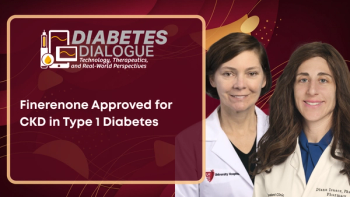
Diana Isaacs, PharmD, and Natalie Bellini, DNP, discuss the FDA's recent approval of Bayer's finerenone in concomitant CKD and T1D.

This episode covers the recent commercial availability of the Pivot patch pump and the upcoming 7-day bolus patch from CeQur.
Welcome back to
To begin the episode, cohosts Diana Isaacs, PharmD, and Natalie Bellini, DNP, discuss the rapidly evolving landscape of wearable insulin delivery, focusing on recent developments in patch pump technology and the growing number of tubeless insulin delivery systems entering the market. The conversation centers on the recent FDA clearance of the Pivot patch pump from Modular Medical, which the hosts describe as an important addition to a field that has historically been dominated by a single tubeless option.
Isaacs reviews the design of the Pivot system, explaining that while it is a tubeless insulin pump, it differs from current automated insulin delivery (AID) systems because it does not communicate with a continuous glucose monitor (CGM) or use an insulin-dosing algorithm. Instead, the device delivers programmable basal insulin with ≤2 selectable basal rates and allows users to administer manual bolus doses. The hosts note its 300-unit insulin reservoir, highlighting the larger capacity as a potential advantage for individuals with higher daily insulin requirements.
Bellini discusses where Pivot may fit into current clinical practice, suggesting it could provide an option for people who are unwilling or unable to use CGM technology but would still benefit from wearable insulin delivery. She also points to the possibility of future partnerships with commercially available AID algorithms, which could allow the platform to evolve into a more automated system. The hosts acknowledge that current diabetes guidelines generally favor AID for individuals with type 1 diabetes but recognize that simplified technologies continue to have an important role for select patient populations.
The discussion expands to the broader pipeline of tubeless insulin pumps currently under development. Isaacs and Bellini review anticipated products from Tandem, Beta Bionics, and Medtronic, noting that virtually every major insulin pump manufacturer is now investing in patch pump technology. They compare reservoir capacities, expected timelines, and device designs while emphasizing the increasing demand for tubeless systems that improve convenience and reduce many of the practical challenges associated with traditional tubing.
The hosts also examine several practical design considerations. They discuss Pivot's reusable and disposable components, explaining that many newer patch pumps incorporate reusable elements because of existing intellectual property surrounding fully disposable tubeless systems. While reusable components may lower manufacturing costs, they also introduce considerations such as the potential for patients to misplace components or inadvertently lose them during hospitalizations. Isaacs adds that the simplified design and absence of an onboard algorithm may ultimately make the device more affordable, although real-world pricing remains to be determined.
Attention then shifts to recent updates from CeQur Simplicity, which recently announced a 7-day bolus-only patch featuring an expanded 240-unit insulin reservoir and a new one-unit dosing option for individuals requiring smaller mealtime insulin doses. The hosts discuss how these enhancements could broaden the device's applicability while maintaining its emphasis on simplicity, requiring neither smartphone connectivity nor a dedicated mobile application.
Bellini highlights the potential synergy between the 7-day patch and emerging once-weekly basal insulin formulations, suggesting that synchronizing weekly basal insulin administration with weekly patch replacement could simplify treatment routines and improve adherence. She emphasizes that insulin therapy should continue to complement guideline-directed pharmacologic management, including GLP-1 receptor agonists, SGLT2 inhibitors, and other glucose-lowering therapies when appropriate.
The episode concludes with an optimistic assessment of the future of insulin delivery technology. Isaacs and Bellini emphasize that increasing competition among manufacturers is likely to expand patient choice, improve affordability, and accelerate innovation. They express particular enthusiasm for the continued growth of tubeless insulin delivery, broader pharmacy benefit coverage, and the next generation of AID systems, all of which they believe will further individualize diabetes management and improve outcomes for people requiring insulin therapy.
Editors’ Note: Isaacs reports disclosures with Dexcom, Abbott, Lilly, Novo Nordisk, Medtronic, Insulet, and others. Bellini reports disclosures with Abbott Diabetes Care, MannKind, Povention Bio, and others.