





Gastroenterology
Latest News

Advertisement
Latest Videos








CME Content




























































Advertisement
More News

In recent years trial designs have evolved to become increasingly complex and sophisticated with new endpoints that could include patient-reported outcomes, biomarkers, mucosal, and histological healing, central endoscopy reading, and trials that examine both induction and maintenance of remission within the same study.
Millie Long, Miguel Regueiro, MD, Maia Kayal, MD, Anita Afzali, MD, and David Hudesman, MD, offer clinical strategies for optimizing treatments for Crohn’s Disease (CD) patients.
Miguel Regueiro, MD, offers his clinical advice on second-line therapies for patients with Crohn’s Disease (CD).

BOS-580 is an investigational, proprietary, long-acting fibroblast growth factor 21 analog as a monthly and bi-weekly treatment for patients with NASH.

The treatment, developed by Intercept Pharmaceuticals, could not be approved in its present form, according to the CRL and any resubmission of the treatment for patients with NASH would require at least the successful completion of the long-term outcomes phase of the REGENERATE study.
Anita Afzali, MD, David Hudesman, MD, and Maia Kayal, MD, discuss how extra intestinal manifestations (EIM) affect therapy strategies for Crohn’s Disease (CD) patients.
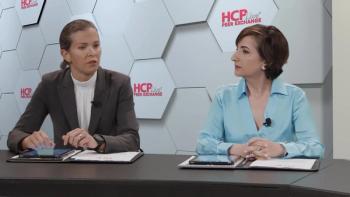
Millie Long discusses treatment considerations for Crohn’s Disease (CD) patients who are planning for pregnancy.

NLR values were similar between significant and minimal fibrosis and were not correlated with significant fibrosis.

Patients with anti-HDV antibodies had a significantly higher prevalence of liver cirrhosis, significantly lower prothrombin time, and a higher prevalence of HIV co-infection compared to patients who demonstrated serum anti-HDV antibody negatively.

Men who have sex with men in Europe were more likely to be in a cluster compared to non-European men who have sex with men.

The US Food and Drug Administration (FDA) approved linaclotide earlier this month for the treatment of patients with functional constipation aged 6-17 years.

The race-neutral model resulted in worse calibration, NPV, and false-negative rates among racial and ethnic minority subgroups compared to non-Hispanic White participants.

There were no new safety signals identified from the COMMAND trial.

Noting that global elimination of HCV will require a commitment from individual communities, Mamta Jain, MD, MPH, discusses the role of primary care providers in the care spectrum.
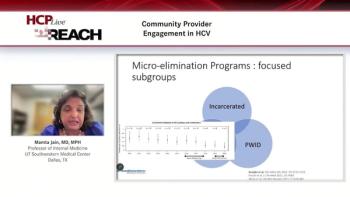
Mamta Jain, MD, MPH, summarizes community outreach efforts regarding the training and education of health workers.

Parvez Mantry, MD, examines the question of why so many patients with HCV do not undergo therapy. He also discusses policy updates aimed at improving screening and expanding access to treatment.
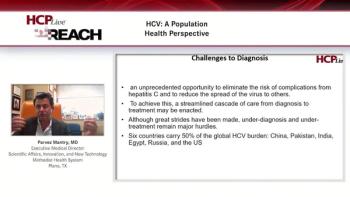
Parvez Mantry, MD, discusses the burden of HCV and challenges to diagnosis and therapy. He also explores general awareness regarding HCV and opportunities for screening.
In the maintenance period, 86% of patients treated icanbelimod completed and 67% achieved clinical remission through week 48.
Experts discuss the results of a five-year efficacy and safety trial of ustekinumab for treatment of Crohn’s Disease (CD).
Anita Afzali, MD, David Hudesman, MD, Millie Long, and Miguel Regueiro, MD, discuss Vedolizumab and Risankizumab as treatments for Crohn’s Disease (CD).

The point prevalence per 100,000 people at the conclusion of the study was 71.8 for autoimmune hepatitis, 38.5 for primary biliary cholangitis, and 11.0 for primary sclerosing cholangitis.

For individuals with hepatitis C virus infections, 52.5% of deaths were deemed attributable to the infection.

Patients with autoimmune hepatitis who were positive for antimitochondrial antibodies and evidence of non-specific bile duct injury had a higher risk of progressing to cirrhosis.

The possibility of clients reacting dismissively and of unsettling clients were viewed as the main barriers preventing better screening within these populations.
The treatment represents the first approval for pediatric patients with functional constipation.
Advertisement
Advertisement
Trending on HCPLive
1
FDA Approves Obinutuzumab (Gazyva) for Idiopathic Nephrotic Syndrome
2
The Case for Routine Kidney Screening, With Pranav Garimella, MBBS, MPH
3
Hereditary Angioedema Triggers, Prodromes Mapped in US HAEA Registry
4
Weekly Insulin Efsitora Alfa (Onswik) Gains FDA approval for Type 2 Diabetes
5