




Gastroenterology
Latest News
Advertisement
Latest Videos







CME Content




























































Advertisement
More News

The retrospective analysis highlights improved outcomes among patients with obesity and a history of bariatric surgery hospitalized with decompensated cirrhosis.
The May 2024 gastroenterology month in review spotlights top research from Digestive Disease Week 2024 and the FDA approval of ColoSense.

Sands reviews key findings from the phase 3 VIVID-1 study of mirikizumab in Crohn’s disease presented at DDW.

Using available literature, the review assesses our current understanding of AATD, emerging biomarkers, and the future of drug development.

Patients with AATD-associated lung disease on augmentation therapy participating in a health management program experienced negligible changes in self-perceived health status.

In honor of World Digestive Health Day, this feature examines the growth of intestinal ultrasound in IBD care in the US and how it aligns with STRIDE-II guidance.

Patients with AATD had increased cardiovascular risk compared to non-AATD COPD and healthy controls, with results suggesting physiological tests may assess risk more accurately.

Lembo describes the potential of a multi-species synbiotic for the treatment of IBS based on findings from an exploratory study he presented at DDW.

Lacy reviews key considerations for the diagnostic evaluation and treatment of abdominal bloating and distension based on his session at DDW.

Singh explains a potential new approach to the low FODMAP diet based on findings from research he presented at DDW suggesting a simplified step-up method.

Intestinal Ultrasound’s Value for Assessing Disease Activity in IBD, with Noa Krugliak Cleveland, MD
Krugliak Cleveland explains findings from research she presented at DDW comparing intestinal ultrasound and conventional approaches to disease monitoring in IBD.

Rezaie reviews findings from a prospective clinical trial of a novel palatable elemental diet, highlighting its 100% compliance rate and strong efficacy.

Panaccione explains findings from GALAXI 2 and GALAXI 3 demonstrating guselkumab’s superiority to ustekinumab in Crohn’s disease, presented at DDW.

Joly explains the burden of parenteral support and the significance of new STARS data showcasing apraglutide’s potential in SBS-IF.
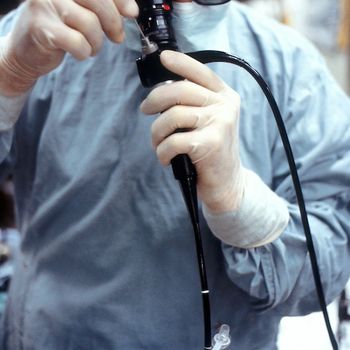
A cable-transmission magnetically controlled capsule endoscopy showed comparability to conventional methods in upper GI tract examinations and lesion detection.

Data from PREEMPT CRC reveal the blood-based screening test demonstrated a 79.2% sensitivity for detecting colorectal cancer.
A detailed overview and accompanying quiz on the recommendations made by the AGA in their 2024 guideline on endoscopic eradication
Both doses of guselkumab exhibited statistical superiority on all prespecified pooled endoscopic endpoints versus ustekinumab in Crohn's disease.

New STARS data were presented in a late-breaking abstract at DDW and build upon positive topline results for clinical responder rates and reductions in parenteral support.

Feuerstadt breaks down findings from an ad hoc analysis of PUNCH CD3 and what the results suggest about the use of live-jslm (Rebyota) in patients taking concomitant medications.

An assessment to improve colorectal screenings by shipping Cologuard kits to non-compliant patients proved beneficial for a Mayo Clinic research team.

The phase 3 QUASAR Maintenance study met its primary endpoint of clinical remission and demonstrated statistically significant endoscopic remission rates in UC treatment.

Sehgal explains the safety and efficacy of GLP-1RAs in patients with IBD as well as the impact on inflammatory biomarkers.

Damas explains key findings from her pilot study exploring intervals of a low-calorie plant-based diet as adjunctive therapy to medication in patients with ulcerative colitis.
Rezaie describes recent trends in GLP-1RA prescription patterns from his population-based research presented at DDW, highlighting increases in off-label use.
Advertisement
Advertisement
Trending on HCPLive
1
The Case for Routine Kidney Screening, With Pranav Garimella, MBBS, MPH
2
FDA Approves Obinutuzumab (Gazyva) for Idiopathic Nephrotic Syndrome
3
Zilurgisertib Receives FDA Approval for FOP in Patients 12 and Older
4
FDA Approves Baricitinib for Adolescents With Severe Alopecia Areata
5