
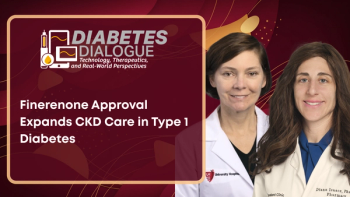
In this segment from the latest episode of Diabetes Dialogue, Diana Isaacs, PharmD, and Natalie Bellini, DNP, discuss the FDA's recent approval of finerenone for CKD with T1D.
In this segment from the latest episode of Diabetes Dialogue, Diana Isaacs, PharmD, and Natalie Bellini, DNP, discuss the FDA's recent approval of finerenone for CKD with T1D.

Andrew Cutler, MD, says real-world MDD patients respond to adjunctive cariprazine like trial participants, with gains in mood and function within weeks.

David Berg, MD, discusses his meta-analysis of 3 major trials of dapagliflozin, which determined its efficacy in reducing cardiovascular death risk.
Frances Lee, MD, on the stigma driving under-detection of ALD and its disproportionate rise in women and younger adults.
SOCS leaders explain SOCS Serves, a toolkit-based program connecting dermatology volunteers with students and underserved communities.
EMBARQ-CSU1 and EMBARQ-CSU2 showed sustained reductions in urticaria, with the antibody meeting all primary and key secondary endpoints at Week 12.

The FDA-approved update adds phase 3 HYPERION data on adults diagnosed with PAH within the past year.

Josh Woolley, MD, PhD, explains why current active placebos fail to mask high-dose psilocybin trials and outlines a framework proposed to fix it.
Raj Chovatiya, MD, PhD, on zasocitinib results in the scalp, nails, palms and soles, speed of response and once-daily oral dosing in psoriasis.
Philadelphia-area PAH specialists discuss real-world patient mismatch with trial criteria, drug sequencing, and insurance access barriers.

Kazem Rahimi, MD, discusses his recent IPD analysis highlighting the consistent relative risk reduction of first cardiovascular event with BP-lowering drugs.
van Ingen, of Radboud University Medical Center, discusses the ENCORE trial's patient-reported endpoint for ALIS in MAC lung disease.
Woolley discusses why an active placebo's own therapeutic effects complicate psilocybin trial blinding and outlines next steps for testing UMBRAA.

FDA expands marstacimab approval to children and patients with inhibitors, backed by new BASIS trial data.
Frances Lee, MD, on stigma's role in ALD care and why women may progress to advanced disease faster than men.
van Ingen, of Radboud University Medical Center discusses data showing add-on ALIS improved durable culture conversion in newly diagnosed MAC lung disease.
In this Q&A, Raj Chovatiya, MD, PhD, discusses where zasocitinib fits in the psoriasis treatment algorithm and what high clearance rates mean for patients.
The sNDA for amikacin liposome inhalation suspension is supported by phase 3b ENCORE trial data, with a PDUFA date of January 28, 2027.

Aquestive has resubmitted its needle-free epinephrine film after an FDA rejection over usability, not efficacy. This FAQ covers what changed.
Stay updated with the latest healthcare breakthroughs, including Bayer's finerenone expanding to type 1 diabetes-associated CKD.
Woolley separates intoxication from delirium and defends aggressive masking instead of a shift to comparative efficacy trial designs.

Selvanayagam shares his thoughts on whether ICDs’ improvements in sudden cardiac death are worth the reduced quality of life.

Fluconazole was linked to improved Mayo and Harvey-Bradshaw scores; Iliev outlines the placebo-controlled trial needed next.
Raj Chovatiya, MD, PhD, discusses how the oral TYK2 inhibitor zasocitinib may affect scalp, nail, and hand psoriasis, clearance speed, and once-daily dosing.
Joseph Selvanayagam, MBBS, discusses the potential of implantable cardioverter-defibrillators to reduce sudden cardiac death among younger patients.
Weill Cornell investigator Iliyan D. Iliev, PhD, explains why fluconazole, not nystatin, cleared gut Candida in IBD.
Josh Woolley, MD, PhD, says active placebos fail to mask high-dose psilocybin and propose combining drug classes with authorized incomplete disclosure.
Diana Isaacs, PharmD, and Natalie Bellini, DNP, discuss the FDA's recent approval of Bayer's finerenone in concomitant CKD and T1D.
Raj Chovatiya, MD, PhD, explains where oral TYK2 inhibitor zasocitinib may fit in psoriasis treatment after the FDA accepted its NDA under priority review.
The FDA has granted Priority Review to dersimelagon for EPP and XLP, setting a PDUFA date for late February 2027 as LEO Pharma completes its acquisition from Tanabe Pharma.