

At ARVO 2023, 24-month data suggests the change from baseline in GA lesion growth consistently favored pegcetacoplan vs. sham across subgroups in DERBY and OAKS trials.
At ARVO 2023, 24-month data suggests the change from baseline in GA lesion growth consistently favored pegcetacoplan vs. sham across subgroups in DERBY and OAKS trials.

At ARVO 2023, Goldberg discusses how dual Ang-2/VEGF inhibition can provide greater vascular stability, which may contribute to faster fluid resolution and extended durability with faricimab treatment.

A personalized treat-and-extend–based regimen presented at ARVO 2023 suggested the long-term potential of faricimab to reduce the treatment burden for patients with DME.

An analysis of the TENAYA/LUCERNE presented at ARVO 2023 suggests faricimab more rapidly improved anatomic outcomes in patients with nAMD compared to aflibercept.
An analysis of the phase 2/3 PHOTON trial suggested the majority of patients with DME who received aflibercept 8 mg maintained 12- or 16-week dosing intervals.

A posthoc analysis of the phase 2 CANDELA study presented at ARVO 2023 suggests aflibercept 8 mg improved visual and anatomical outcomes compared with aflibercept 2 mg in eyes with nAMD.

At ARVO 2023, Do discusses the benefit of aflibercept 8 mg for DME in the phase 2/3 PHOTON trial, demonstrating non-inferiority in BCVA vs aflibercept 2 mg and no new safety concerns.

Presented at ARVO 2023, the nationwide data on nAMD real-world management in France suggest a discrepancy between avoiding the undertreatment of nAMD and the real-world management of the disease.

New research presented at ARVO 2023 suggests intravitreal brolucizumab led to the resolution of IRF and SRF in a significant number of patients with nAMD previously unresponsive to anti-VEGF therapy.
In an interview at ARVO 2023, Danzig discusses the post-hoc analysis from the GATHER trials, showing that a reduced rate of vision loss in patients receiving avacincaptad pegol was correlated with reduced GA growth.

At ARVO 2023, Caroline Baumal, MD, chief medical officer of Apellis Pharmaceuticals, discussed new phase 3 functional analyses of pegcetacoplan injection, the future of the GA treatment landscape, and the next unmet need in ophthalmology.

Phase 3 results presented at ARVO 2023 suggest a switch from aflibercept to SB15 led to no treatment-emergent issues such as loss of efficacy, increased adverse events, or increased immunogenicity.

An analysis of the STATUS program suggests the percentage of patients that received an annual eye exam increased from 65.2% to 72.8% in the clinics utilizing the IDx-DR system.

An analysis of the AlzEye study presented at ARVO 2023 suggests a deep-learning model showed promise in predicting three-year incident MACE using OCT.
As part of our ARVO 2023 coverage, Dr. Sheth sat down with Pravin Dugel, MD, President of Iveric Bio to discuss avacincaptad pegol for geographic atrophy and a look back at Dr. Dugel's career and his transition into industry.
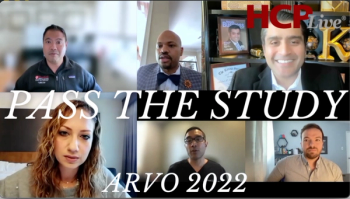
In the first episode of this new game show, a team of ARVO 2022 investigators work to invent an innovative clinical trial.
From curative stem cell approaches to in-clinic subretinal injections, Arshad Khanani, MD, MA, navigates what the future drug class may entail.
An FDA decision could come as soon as this year. One expert stresses the need for improved screening, biomarker research, and patient communication beforehand.
Study author Arshad Khanani, MD, MA, discusses how the novel-targeting gene therapy candidate may uniquely benefit patients with treated retina disease.
Theodore Leng, MD, MS, discusses his team's IRIS registry findings suggesting a need for quantifying how vision-loss patients are impacted by functional or quality-of-life measures.

Data show half of all eyes with CRVO were still being treated at 36-months.

Treatment delay and steroid usage were both associated with worse improvements in long term BVA and CST in patients with RVO-related macular edema.
Veeral S. Sheth, MD, MBA, gives an update on his practice's adoption of the novel PDS in patients with AMD—and discusses other potential methods of anti-VEGF delivery.
These data further elucidate the relationship between mental health and diabetic retinopathy.

However, data show RVO patients with clinical findings associated with glaucoma risk are often not coded with suspected glaucoma.

A new assessment from ARVO 2022 showed methodology to predict one-year treatment response to treat-and-extend ranibizumab at 1 year.

The study agent was otherwise not associated with an increased number of intravitreal injections over a 12-month period.
Veeral S. Sheth, MD, MBA, discusses promising agents in development for geographic atrophy and other under-addressed ophthalmic diseases.

Patients with DR had an average interval between anti-VEGF injections of 70 days, compared to 54 days for RVO patients and 55 days for wetAMD patients.
One researcher suggests the supplement may serve as an add-on measurement against AMD progression in early-stage patients.