




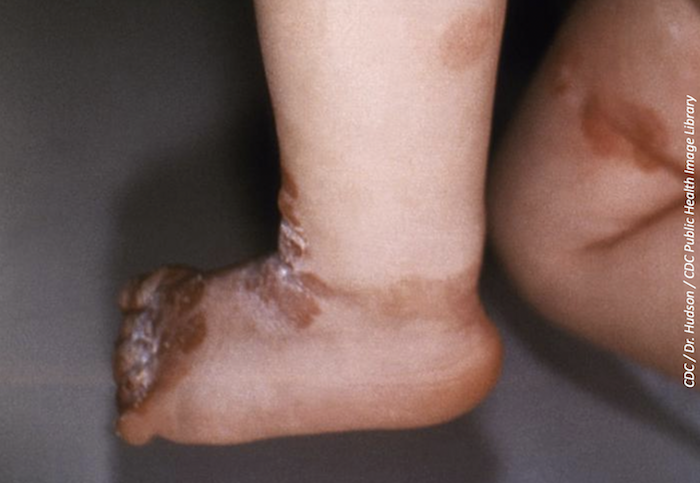























































Onchocerciasis, also known as river blindness, may now be detectable through a urine diagnostic developed by investigators from Scripps Research Institute.
Onchocerciasis, also known as river blindness, may now be detectable through a urine diagnostic developed by investigators from Scripps Research Institute.

The FDA has granted an orphan drug designation to OBI Pharma, Inc.’s OBI-3424 for the treatment of acute lymphoblastic leukemia.

The FDA has granted a rare pediatric disease designation to Lin BioScience’s LBS-008 for the treatment of Stargardt disease.

The FDA has granted an orphan drug designation to Cytori Therapeutics’ ATI-1123 chemotherapy drug for the treatment of small cell lung cancer.
Cure CMD (Congenital Muscular Dystrophy) is pleased to announce the recipient of a grant co-funded with Muscular Dystrophy UK: Dr. Giséle Bonne at the INSERM-Myology Institute in Paris.

Bridge the Gap – SYNGAP Education and Research Foundation presented Texas Children’s Hospital with their first research grant of $25,000.

The FDA has granted a fast track designation to miransertib for the treatment of PIK3CA-Related Overgrowth Spectrum, a group of ultra-rare genetic disorders.

Stay up-to-date on the latest rare disease news by checking out our top 5 articles of the week.

The National Institutes of Health has launched the Cure Sickle Cell Initiative to accelerate the pace at which genetic-based curative therapies are developed for sickle cell disease.

The FDA has approved a device intended for the treatment of acute coronary heart perforation, a rare, but potentially life-threatening complication of heart vessel procedures.

Moxetumomab pasudotox (Lumoxiti, AstraZeneca)is approved for adults with relapsed or refractory HCL who received at least 2 prior systemic therapies, including treatment with a purine nucleoside analog.

The FDA has approved the subcutaneous formulation of tocilizumab (Actemra) for the treatment of active systemic juvenile idiopathic arthritis in patients two years of age and older.
The FDA has granted an orphan drug designation to Syntimmune Inc.’s SYNT001 for the treatment of pemphigus.

The FDA has granted a fast track designation to pamrevlumab for the treatment of patients with idiopathic pulmonary fibrosis (IPF).

An investigative team from St. Jude Children’s Research Hospital have identified weaknesses to target in rhabdomyosarcoma, leading to a promising precision medicine treatment that has already hit clinical trials.

Pauline Funchain MD, shares how artificial intelligence may serve as a potential breakthrough for treating rare diseases in the future.

The FDA has granted a fast track designation to Immune Pharmaceuticals, Inc.’s bertilimumab for the treatment of bullous pemphigoid.

The FDA has denied accelerated approval for Pompe disease treatment, AT-GAA. However, plans for a pivotal study are still underway, so approval could be forthcoming.

Investigators find telavancin has potent in vitro activity and low resistance development potential when used against S aureus isolates in patients with cystic fibrosis.

There’s no cure for Huntington’s disease, but a new study by investigators in Sweden is exploring potential new approaches to treating the neurodegenerative disease.

Stay up-to-date on the latest rare disease news by checking out our top 5 articles of the week.

E. Anders Kolb, MD, discusses the exciting possibilities of using genomic technologies to stratify pediatric cancer patients.

Daniel Ontaneda, MD, provides insight into the implications of discovering a new subtype of multiple sclerosis: myelocortical MS.

ProQR Therapeutics has announced positive interim results from its phase 1/2 clinical trial evaluating QR-110 as a potential treatment for Leber’s congenital amaurosis 10 (LCA10).

The first part of a recent phase 1/2a trial has met its primary objectives, demonstrating safety & tolerability of SYNB1618 in healthy volunteers & identifying a suitable dose to evaluate in patients with PKU.